

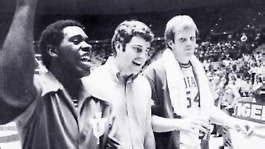
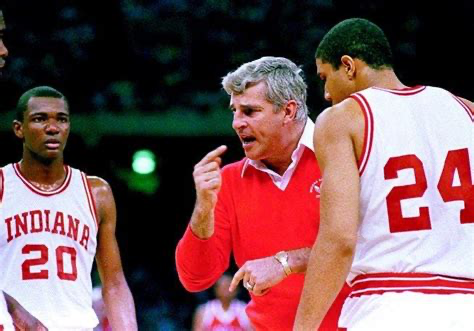
On November 1, 2023, college basketball lost a legend. Coach Bob Knight passed, leaving quite the legacy. His 43-year coaching career began at Army from 1965-1971. From 1971 to 2000 he coached Indiana University, winning three NCAA National Championships, one National Invitational Tournament Championship, and 11 Big Ten Championships. He coached the U.S. Men’s Basketball team to a Gold Medal in 1984. He was National Coach of the Year 3 times, and the Big Ten Coach of the Year 8 times. He coached the Texas Tech Men’s Basketball Team from 2001 to midway through 2008, turning the team over to his son Pat Knight. He took Texas Tech to the NCAA tournament 5 times. His championship team from 1976 was the last national championship team to be undefeated.

Coach Knight, also know as “The General“, was also know for his fiery temper. In one infamous incident during a rivalry game in 1985, Coach Knight threw a chair across the floor while an opposing player was lined up for a free throw. He was ejected from the game. Later on, when asked why he threw the chair, he replied, “I noticed during the game that there was an elderly woman standing court-side. She looked tired, so I tossed her a chair.” You can bet that story grew in the telling!
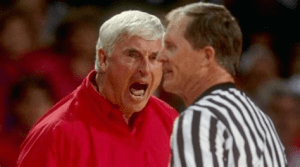
He lost his job at IU in 2000, after allegedly choking one of his players during a practice. He was often prickly during media interviews. After an NCAA tournament win against Temple, Leslie Visser of CBS Sports, asked him how Indiana was able to beat Temple. Without missing a beat, Coach knight replied, “Well, Leslie, we scored more points than they did.” She was not used to coaches answering her in that fashion. But if he thought a reporter was asking a stupid question, he let them know it.

He was a complex man, who brought out the knives, and the plaudits, from others. I was a student at Indiana University from 1981 through 1987. I was getting a Bachelor of Science in Education, and I aspired to be a coach. I saw that Coach Knight taught a Coaching of Basketball class, and I thought, “There it is!” I was warned not to take it. Various people told me different stories. He wasn’t present for any of the classes. He had his assistant coaches do them. Nobody really learned anything, he just “mailed it in”. I held to my own counsel, and signed up.

Class was held in Assembly Hall, the arena where IU played their games. We were directed to a classroom deep in the building, and 15-20 of us sat in the classroom, waiting to see what would happen. Then, the door opened, and in walked a living legend. Coach was tall. He played ball himself, and was around 6 foot 6 inches tall. His eyes were intense. He looked at you like he was weighing your worth, and figuring out ways to increase that worth. Ways that would be uncomfortable, demanding, and exhausting.
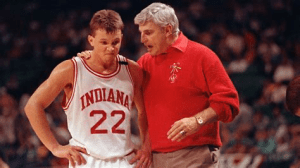
He spoke, “Welcome to Coaching of Basketball. There are two requirements for this class. The first requirement is to be here every time, on time. If you miss, or are late for, one class, you’ve earned a C. The second time, you’ve flunked this class. If anyone here can’t deal with that now is the time to leave, and drop this class.” Three guys actually got up and left. Assembly Hall was on the north side of the campus, and was away from other class buildings. It was quite the walk, and the bus system had yet to be developed. For some, the logistics were too much.

Coach didn’t appear to be bothered. He told those of us remaining, “The other part of your grade is a notebook. You are to record everything you learn in a notebook. You will turn that in near the end of the course. It will be evaluated for its content, then you will get it back, hopefully to use when you start your coaching careers.” He looked around the room with his intense gaze. “Any questions?” Nobody moved a muscle.

The class met once a week. We had 45-60 minutes in the classroom. Coach would cover various areas of the came of basketball, then we would head to the Assembly Hall floor to be run through drills for the skills were learning. Assistant coaches ran us through the drills. It had been several years since I had gone through basic training, but the amount of profanity thrown my way was very reminiscent. I was in the best shape of my life, I was moderately good at the state sport of Indiana, but when I hit the floor, I couldn’t top anything right. The assistants were good enough to let me know, and applied correction. It was cool. We all felt like we were on the IU Basketball Team, which made up for the invective thrown our way.

The best part was, at the end of each class, Coach had a question and answer session. We could ask him anything, and he would opine on it in his direct way. One class, a young man with long hair, stood top and asked a question. Coach answered his question, then said he had a question for the young man. Coach asked, “How will you find yourself a job with hair like that?” The young man didn’t bat an eye and replied, “I’m young and in college. When I go out into the job market, I will clean myself up.” Coach approved of that answer. He appreciated the young man’s strength and honesty.
The second class we had, a student came in 10 minutes late. He was sweaty and breathing heavily. Coach, who had been speaking, acerbically asked, “Where the Hell have you been?” The student replied, between pants, “I have a class in Jordan Hall…” (Which is across campus, quite some distance away.) Coach interrupted him, “Well, you had better drop that class. You’ve now got a C, and if you’re late again, you’ll fail this class.” We didn’t see him again.

At one class, a young man stood up and asked, “How do you coach quickness?” Coach paused at that. After few moments thinking, he said, “I think it will be easier for me to show you than to tell you.” He pointed across the room at a box of chalk on a chalkboard. “Would you bring me that box of chalk to me, please?” The young man looked over at the box of chalk, got up, got the box and took it over to Coach. Coach thanked him and had him put it back. When the young man was seated, Coach pulled out his wallet and took out a $20 bill.

He looked at the young man and said, “If you can do the same thing before I count to ten, I’ll give you this $20 bill. GO!” The young man sprang up, ran across the room, grabbed the box of chalk, and ran toward Coach, who had been silent the whole time. Just as the young man got to Coach, Coach said, “Ten.”
The young man froze in place, his arm with the box of chalk outstretched towards Coach. The rest of the class burst out laughing. Coach had a slight smile on his face as he spoke to the young man, “Would you like to try again? I’ll give you a standing start!” The young man chuckled and replaced the chalk on the chalkboard. “No,” he said ruefully, “I’m good.”
When the laughing died down, Coach explained. Quickness can’t be taught. One is either quick, or they were not. A coach’s job was to bring out what quickness the athlete had. It was a great point that came in handy, not just in coaching, but in teaching, and in fatherhood.
I ended up with an A in that class. My notebook did come in handy when I coached a seventh grade boys basketball team the next year.

Coach’s legacy extended far beyond the court. Every year he gave a talk to the student body, for free. He always talked about life lessons, not basketball, and he always opened up the floor for questions at the end. One year a student, someone I vaguely knew from my high school, got up and asked a question. The student was overweight. Coach answered with a non sequitur, “Why don’t you lose weight?” There were gasps all around the hall. Some people would have wilted, but not this young man. He stood tall, looked directly at Coach and said, “I’ve tried many things to lose weight.” A young college student like myself doesn’t have the resources to make it work.” Coach nodded, then answered his question.
A bit later I learned the next day Coach called him and asked him to come to Assemble Hall. When he got there, he was met by the team nutritionist, and the team’s strength coach. They had worked out a nutrition plan, and a workout plan. Everyday he went to Assembly Hall to workout. He lost weight, and ended up as a student manager of the basketball team. I heard later that he ended up coaching.
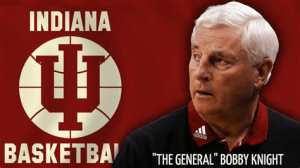
Like I said, Coach was a complex man. He appreciated directness, and respected strength. He never touted his good deeds, and he loved his players like sons. His teams were always a joy to watch. He was a master of the motion offense, and his teams never played anything but man-to-man defense. He was more proud of his graduation rate than his titles and awards. He got great pleasure out of seeing his players go and be successful.
His death was a loss to the sport of college basketball, but he will always be a Legend in Indiana. Here in Indiana, Basketball is King, and he was definitely royalty. He won over 900 games, but dozens of former players are his true legacy.
I am honored to have been one of his students.
 Meditations of a Bald, Fat Guy